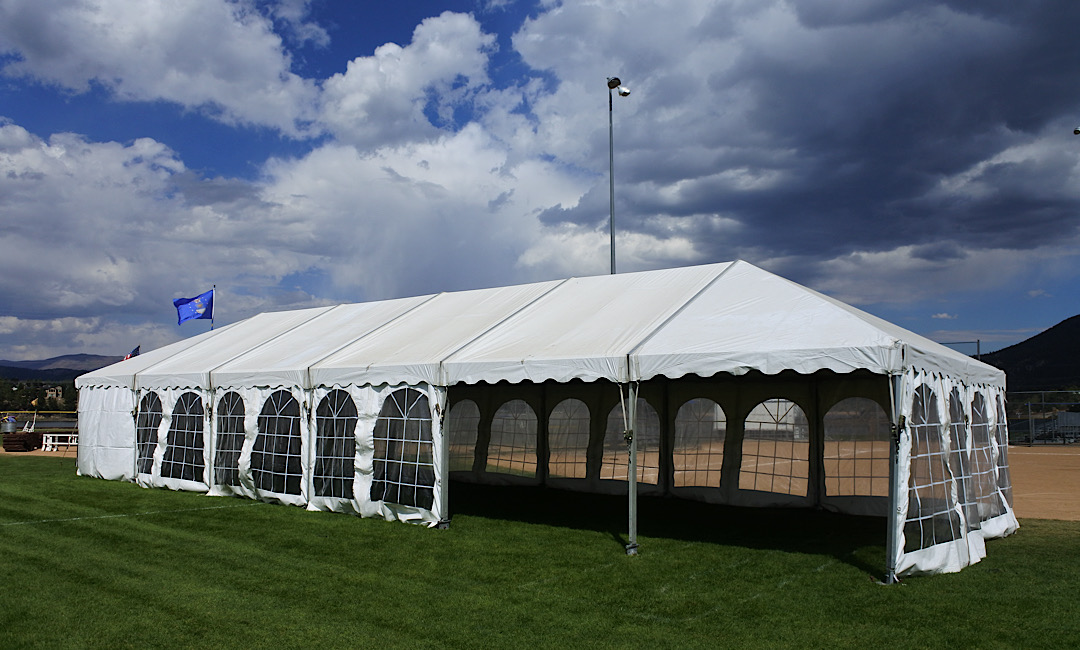
A tent that works in July does not automatically work in January, and the reasons are structural rather than seasonal preference. Mountain View Tent Company installs through the cold months every year, and the choice comes down to four factors: how big the event is, where it sits, how long it stands and what it has to hold up against.
Event size
Cold weather removes the overflow option. In summer, a tent can be sized for the seated portion of an event because people spill out onto the grass for everything else. From November on, they do not. Every guest, every service function and every piece of equipment needs to be inside the footprint for the whole event, which usually means a larger structure than the same guest count would take in June. Work from what has to fit under cover at once, then look at what carries it on the tent styles page.
Location and surface
Winter narrows the ground options. Frozen ground behaves differently from soft ground, and a site that looked straightforward in October can be a different proposition in January. Hard surfaces are often the better answer in cold months: we anchor into asphalt and concrete routinely, and patching the anchor points when the tent comes out is included.
Access is the other half. A truck still has to reach the site, turn and leave, and that route has to work after a plow has been through. Ask early where plowed snow gets pushed, because a bank in the wrong place takes a corner of your footprint with it. Our site preparation checklist covers access, ground conditions and drainage in detail.
Duration
How long the structure stands changes what it should be.
- Single day. The structure needs to handle the conditions on one date, and the install and removal windows are the tight part.
- Multi-day. The tent stands overnight, unattended, through whatever arrives while nobody is watching. That raises the bar on the structure and on where it sits.
- Multi-week or longer. Now it is a semi-permanent installation and a different conversation, including engineering documentation. See Colorado tent wind ratings for long-term outdoor structures.
What the structure has to stand up against
This is the factor people weigh last and should weigh first in winter. Not every tent style is built the same way, and the differences in how the fabric attaches, how the structure anchors and how it sheds what lands on it are what separate a weather-resistant structure from one that is only meant for a summer afternoon. The detail is covered in tents that can withstand Colorado’s wild weather, and it is worth reading before you choose.
Sidewalls belong in this part of the decision rather than the comfort part. Enclosing a structure changes how it sits in wind, and it should be specified with the tent, not added as an afterthought. Standard matching walls come with the tent and specialty walls are priced separately.
Putting the four together
Work them in order. Size tells you which structures are even candidates. Location and surface eliminate some of those. Duration decides whether this is an event install or a semi-permanent one. What it has to stand up against decides among what is left. For general selection factors outside the cold season, see how to choose the right tent for your event.
Tell us the date, the count, the surface and how long it stands when you request a quote, and the structure recommendation comes back with reasons attached.