Two of our structures come up more than any others in this conversation, and people usually arrive knowing they want one without knowing which. Mountain View Tent Company designs and builds its tents in-house, so this comparison is between things we actually make rather than categories from a catalog. Full specifications live on each product page. What follows is the decision.
The structural difference
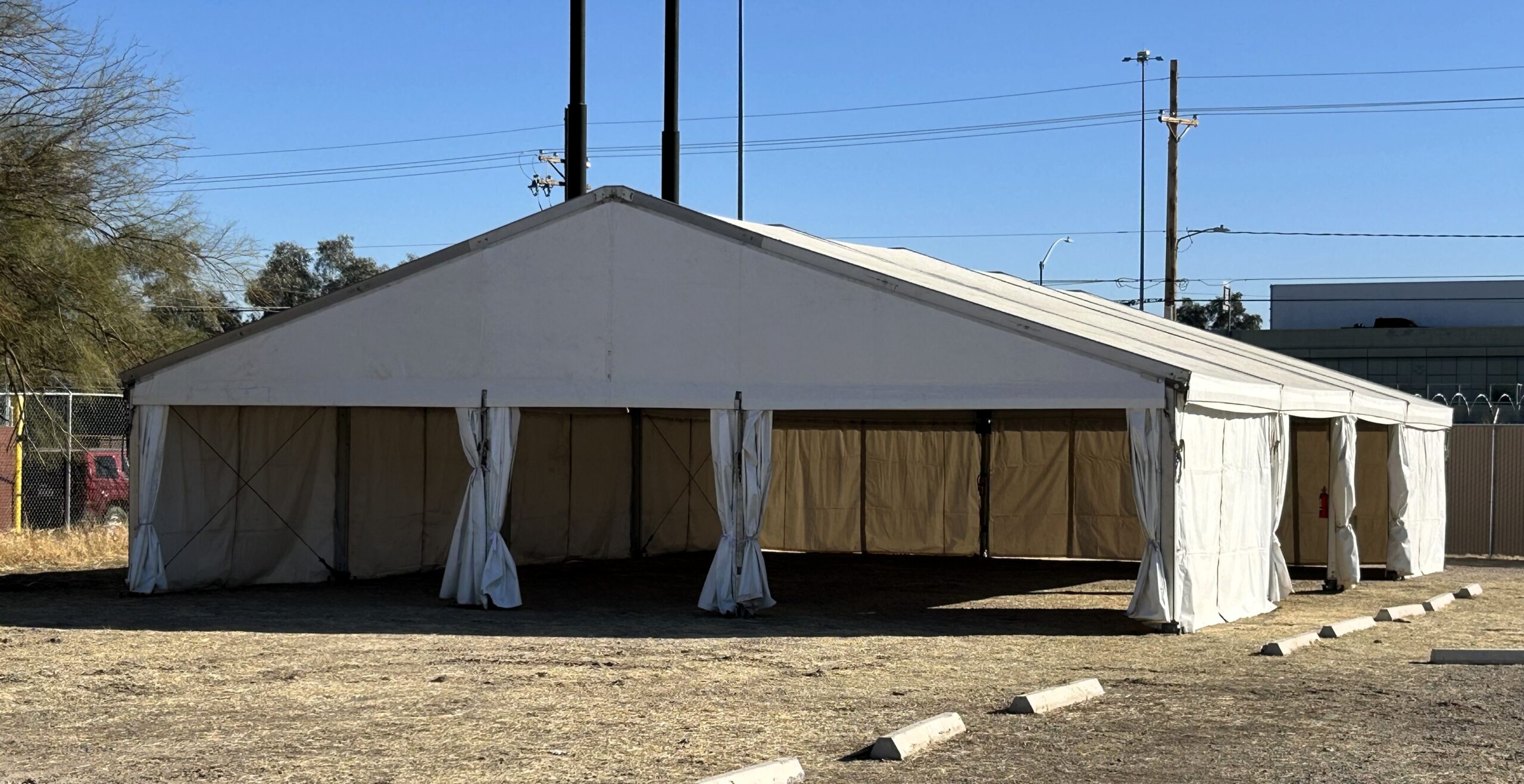
The Super Tent® is a clear-span structure with no center poles and no guy ropes around the perimeter. It anchors at the base of each leg, the fabric is fixed to the framework in tracks, and the sidewalls are fixed to each leg, which is what makes it hold up the way it does.
The Unique™ Frame Tent is built on a rectangular framework and is also a clear span with no center poles. Its fabric is likewise fixed to the framework in tracks, including the sidewalls, and it needs no guy ropes either. It can be installed on grass, concrete or asphalt.
Both give you the full interior with nothing in the middle of it. The difference is scale and shape, not whether you will be routing tables around a pole.
Size and scale
The Super Tent comes in widths of 30, 40, 50, 60, 80, and 100 feet and can be set to any length in 15-foot increments, which is how a 40 by 60 or a 60 by 90 gets built. It is the structure for events that keep growing.
The Unique Frame comes in widths of 10, 20, and 30 feet, with lengths set in 10- to 15-foot increments. That range covers a great deal of real-world work: the mid-size company gathering, the tent over a patio, the event that has to fit a specific piece of ground rather than the other way around.
Layout flexibility
On the Super Tent, legs sit 15 feet apart and an opening can be made between any two of them, so entrances, service access and dining flow can be placed where the event needs them instead of where the structure allows them.
The Unique Frame can be set with hip ends, gable ends or one of each, which changes the look of the entrance and the roofline more than it changes the floor. If the tent is going to be photographed from the outside, that choice matters.
Which events land where
Reach for the Super Tent when the guest count is large, when the event runs multiple days, or when the structure has to stay up through changeable weather. Reach for the Unique Frame when the footprint is mid-size or narrow, when the surface is a patio or a drive, or when the tent has to fit a defined space cleanly.
Traditional Frame, briefly
We also carry Traditional Frame tents in 10×10, 10×20, 20×20 and 20×30. They use a pipe frame with sidewalls that hang freely around the outside, and they suit small gatherings, concessions and supplementing a larger main tent. Inventory and sizes are limited, so ask early if that is the direction you are heading.
The rest of the lineup, in a line each
Tension Top tents come in 20×20 and 20×40, with high swooping peaks and an elevated center pole that stays out of the way. They anchor at the base of each leg with no perimeter guy ropes, and openings can be made between any two legs, which sit 10 feet apart.
Festival tents are a different animal: a classic rope tent with center poles and sidewalls that hang freely around the outside. They run 20×30 and 20×40 at the small end, with widths of 30, 40, 60, 86, and 120 feet above that, set to any length by adding middle sections. They need six feet of staking area around the perimeter, and they are relatively inexpensive, which makes them a sound choice for covering a large area for a short period.
Custom work is its own category. Because we build in-house, we can set any of our tents on taller legs, offer configurations outside the standard sizes, and build to order.
A quick way to choose
- Over roughly 30 feet wide, or growing: Super Tent
- Under 30 feet wide, or fitting a defined space: Unique Frame
- Openings needed in specific places: Super Tent, Unique Frame or Tension Top
- A large area covered economically for a short run, with center poles acceptable: Festival
- Small, supplementary or short: Traditional Frame
All styles sit side by side on the tent styles page. For selection factors beyond structure, see how to choose the right tent for your event. When you know the direction, get a quote and we will confirm the size against your site.